isbn-13: 9781490000000
Audible
AI Generated Content
Generated by gemini-3-pro-preview
Introduction
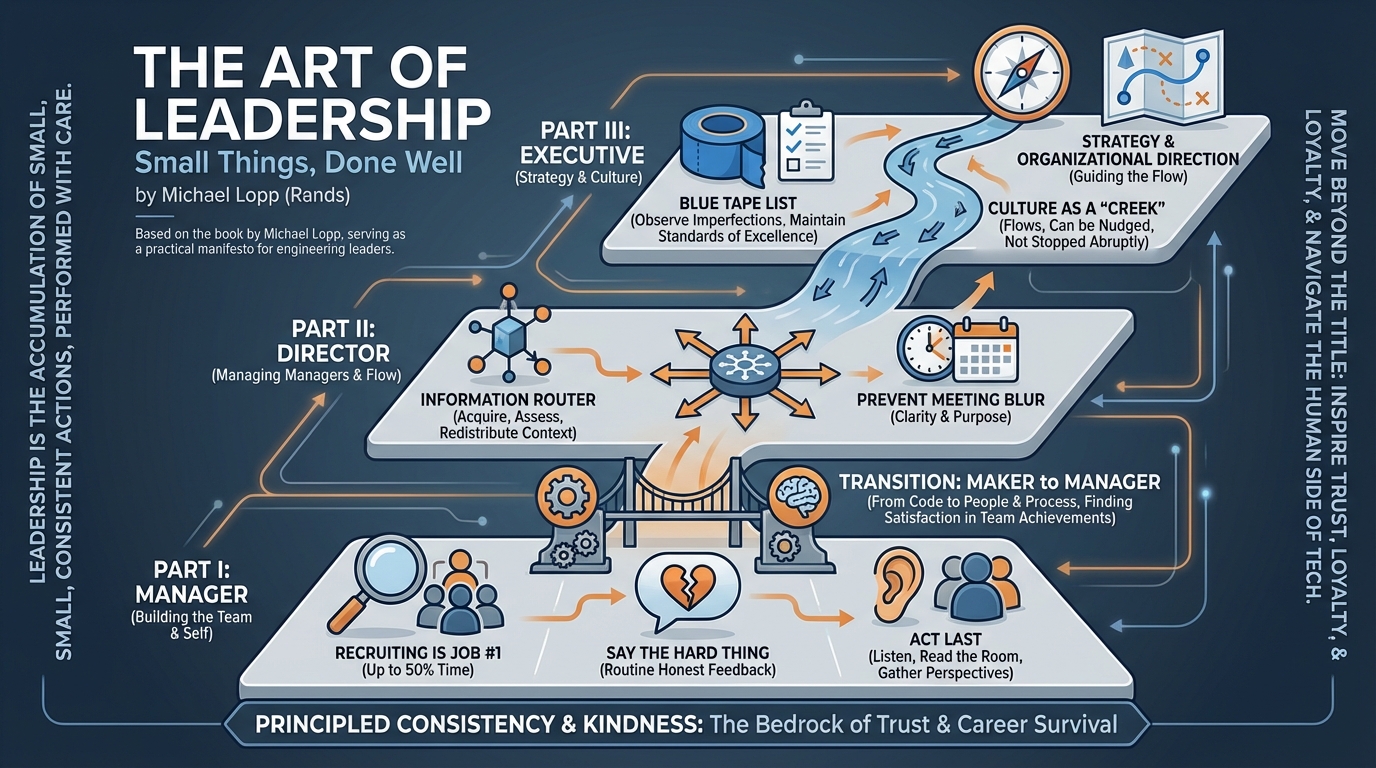
“The Art of Leadership: Small Things, Done Well” by Michael Lopp (often known by his blog pseudonym “Rands”) serves as a practical manifesto for engineering managers and leaders in the technology sector [3]. Drawing from his extensive experience at industry giants such as Netscape, Apple, and Slack, Lopp avoids high-level academic theory in favor of actionable, on-the-ground advice. The book is structured chronologically, mirroring the typical evolution of a leadership career. It guides the reader through three distinct stages: first as a Manager (Part I), then as a Director managing other managers (Part II), and finally as an Executive dealing with strategy and organizational culture (Part III) [3]. Lopp argues that effective leadership is not built on grand, dramatic gestures, but rather on the accumulation of small, consistent actions performed with care and integrity.
Overview of the key points
Lopp provides several concrete strategies for navigating the complexities of management. A central tenet is that recruiting is job number one. He posits that building the team is the most critical activity a manager performs, suggesting that leaders should be prepared to dedicate up to 50% of their time to sourcing, interviewing, and selling candidates when in growth mode [2].
Another crucial skill is the ability to “Say the Hard Thing.” Lopp emphasizes that managers must overcome the natural fear of conflict to provide honest feedback. By making difficult conversations a routine part of the relationship rather than a rare, terrifying event, leaders build trust and prevent issues from festering [2].
The book also redefines the manager’s role as an information router. Lopp estimates that half of a manager’s job involves acquiring, assessing, and redistributing information to ensure the right people have the context they need to make decisions. This helps prevent “Meeting Blur” and organizational confusion [2].
In terms of meeting dynamics, Lopp advises leaders to “Act Last.” By withholding their opinion until others have spoken, leaders can read the room and gather unbiased perspectives before influencing the group with their authority [3].
Finally, the concept of the “Blue Tape” list serves as a metaphor for maintaining standards. Just as blue painter’s tape left on a wall indicates unfinished work, leaders must be observant of small organizational imperfections and address them to set a standard of excellence for their team [3].
Overview of the key themes
Principled Consistency is a foundational theme throughout the book. Lopp argues that trust—the currency of leadership—is earned through predictable behavior over time. Employees need to know that their leader will react consistently to problems and opportunities, creating a stable environment where the team can focus on their work [3].
The transition from Maker to Manager is another significant theme. The book addresses the identity crisis many engineers face when they move from writing code (which offers the immediate gratification or “sugar high” of completion) to the more ambiguous, long-term work of building people and processes. Lopp validates this struggle and offers a roadmap for finding satisfaction in the achievements of the team rather than individual output.
Culture as a “Creek” offers a realistic view of organizational change. Lopp describes culture not as something you can simply install or rewrite, but as a flowing body of water. A leader can nudge it or divert it slightly, but trying to stop or reverse it abruptly is often futile. Understanding the existing flow is a prerequisite to effectively guiding it in a new direction [3].
Underpinning all these themes is the necessity of Kindness. Lopp concludes that in a relatively small industry, one’s reputation is paramount. Being unfailingly kind and respectful is not just a moral choice but a strategic one for long-term career survival and success [2].
Conclusion
“The Art of Leadership” distinguishes itself by focusing on the micro-interactions that define a leader’s day-to-day reality. It is a guide for those who want to move beyond the title of “manager” to become true leaders who inspire trust and loyalty. By focusing on doing the “small things well”—from running effective 1:1s to spotting the “blue tape” in an organization—Michael Lopp provides a comprehensive manual for navigating the often messy human side of software engineering. It is an essential read for anyone looking to scale their leadership skills from the team level to the executive suite.
Further Reading
- “Managing Humans” by Michael Lopp: The author’s earlier work, focusing on humorous and insightful tales specifically about engineering management [3].
- “High Output Management” by Andrew Grove: A classic text on management metrics and leverage that complements Lopp’s practical advice.
- “Radical Candor” by Kim Scott: Offers a deep dive into the feedback mechanisms Lopp discusses, specifically how to care personally while challenging directly.
- “The Five Dysfunctions of a Team” by Patrick Lencioni: A leadership fable that explores why teams fail, frequently cited as a companion to Lopp’s work on team dynamics [3].
- “The Coaching Habit” by Michael Bungay Stanier: Focuses on the art of asking questions, which aligns well with Lopp’s advice to “Act Last” and listen more than you speak [1].
Sources
- [1] National CIO Review: CIO Essentials - Must-Read Leadership Books: https://nationalcioreview.com/articles-insights/cio-essentials-the-must-read-leadership-books-of-the-year/
- [2] Box Kite Machine: Notes on The Art of Leadership: https://boxkitemachine.net/posts/the-art-of-leadership-michael-lopp/
- [3] O’Reilly Media: The Art of Leadership Overview: https://www.oreilly.com/library/view/the-art-of/9781492045687/