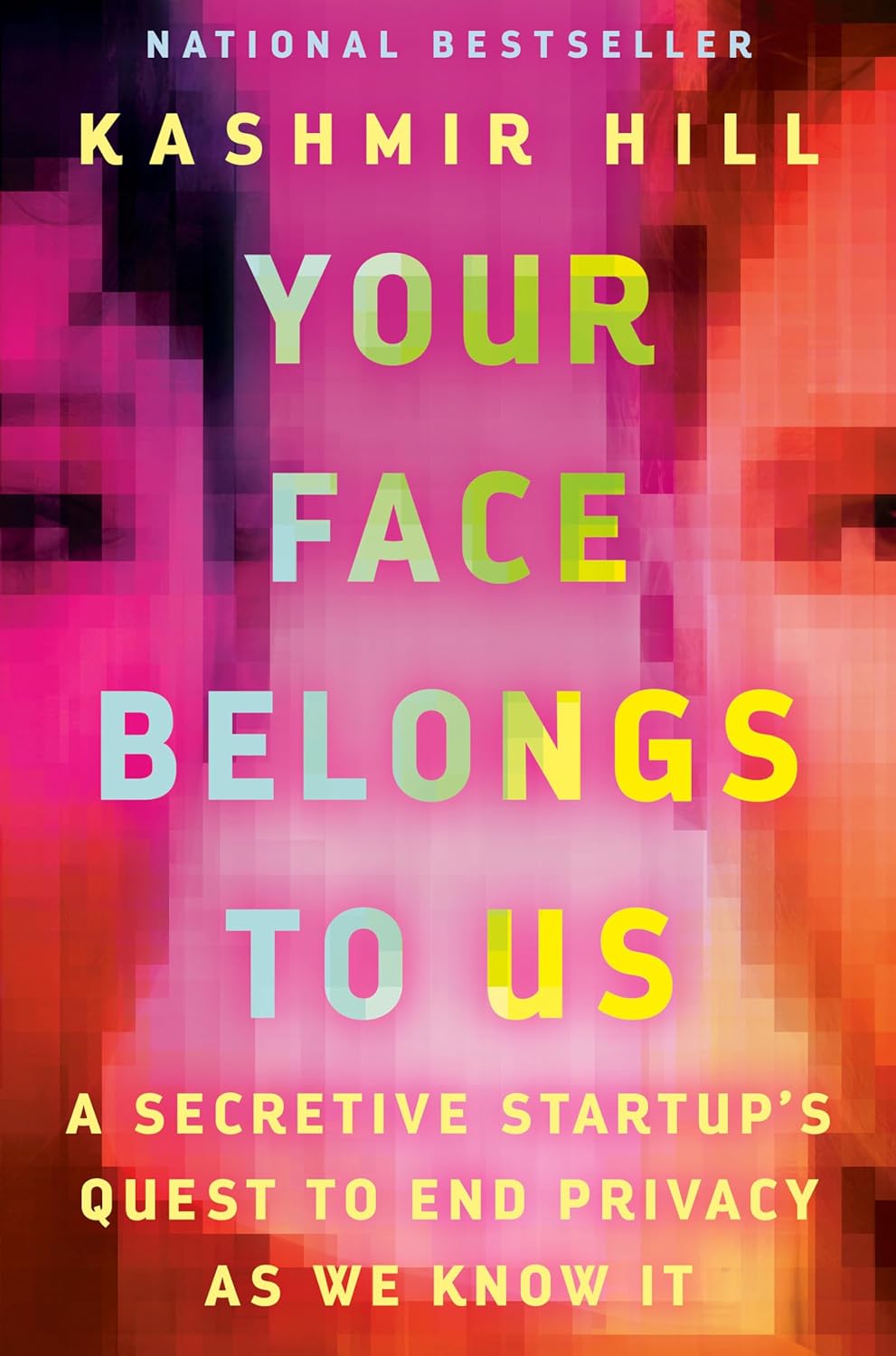
isbn-13: 9780593448571
Audible
AI Generated Content
Generated by gemini-3-pro-preview
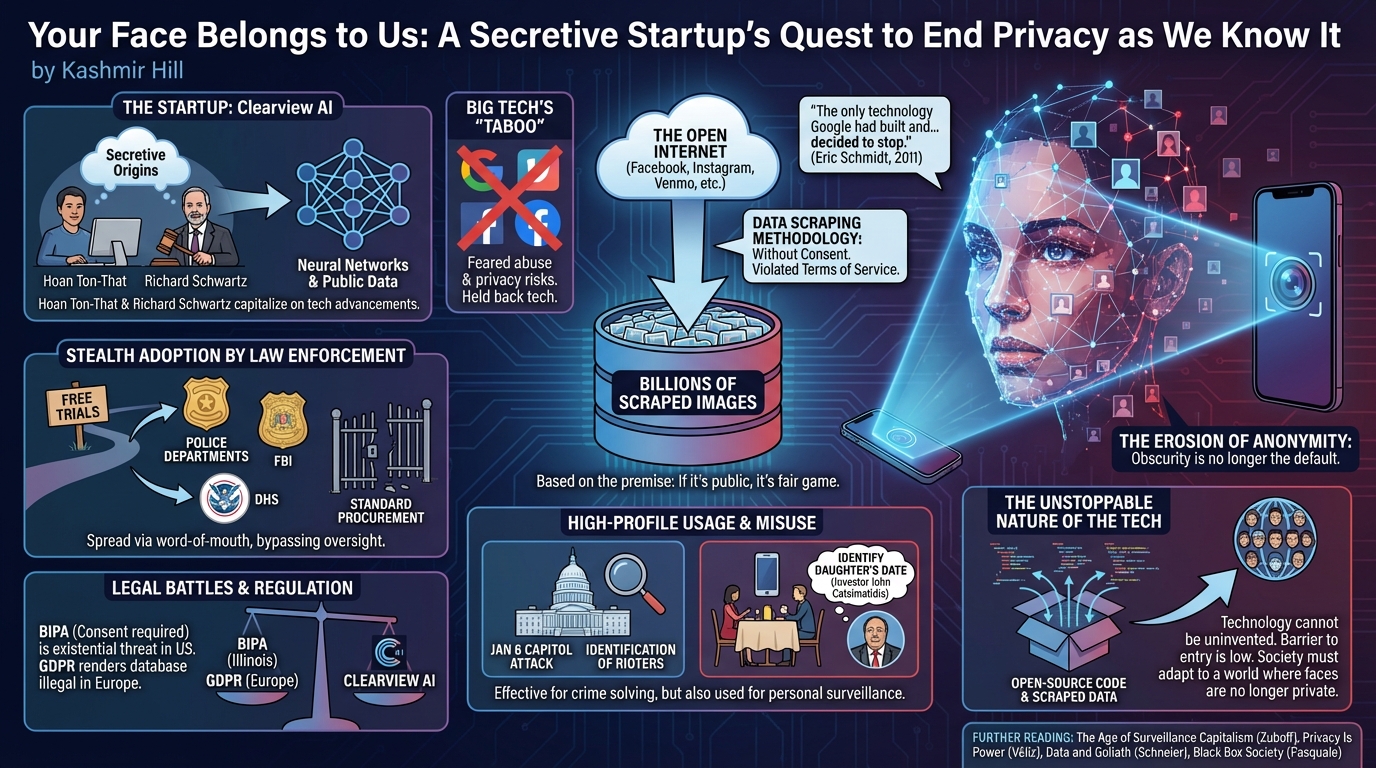
Your Face Belongs to Us: A Secretive Startup’s Quest to End Privacy as We Know It chronicles the rise of Clearview AI, a technology company that developed a facial recognition app capable of identifying individuals by matching their photos against a database of billions of images scraped from the open internet. Author Kashmir Hill, a technology reporter for The New York Times, expands upon her investigative reporting to detail the history of facial recognition technology, the biography of Clearview’s founder, and the legal and ethical ramifications of biometric surveillance.
Key Points
The Origins of Clearview AI:
The narrative centers on Hoan Ton-That, an Australian computer engineer who moved to the U.S. and initially struggled to find success in the tech industry. After a series of failed ventures and viral apps, Ton-That partnered with Richard Schwartz, a politically connected associate of Rudy Giuliani. Together, they capitalized on advancements in neural networks to create a facial recognition tool that utilized the vast, publicly accessible images found on social media platforms like Facebook, Instagram, and Venmo.
The “Taboo” of Big Tech:
Hill documents that tech giants such as Google and Facebook possessed the capability to create similar global facial search engines years before Clearview AI appeared. However, these companies deliberately chose not to release such tools due to the potential for abuse and severe privacy concerns. In 2011, Google chairman Eric Schmidt described facial recognition as the “only technology Google had built and, after looking at it, decided to stop” (p. 67), citing the likelihood of it being used by stalkers or repressive regimes.
Data Scraping Methodology:
Unlike traditional law enforcement databases that rely on mugshots or driver’s license photos, Clearview AI scraped billions of images from the public internet without the subjects’ consent. The company operated on the premise that if information is public, it is fair game for collection, a stance that violated the Terms of Service of nearly every major social media platform.
Stealth Adoption by Law Enforcement:
The book details Clearview’s strategy of bypassing standard government procurement processes. The company offered free trials directly to individual officers and investigators, allowing the tech to spread rapidly through word-of-mouth among police departments, the FBI, and the Department of Homeland Security before high-level administrators were aware of its use.
The Erosion of Anonymity:
A central theme of the book is the loss of “obscurity.” Hill argues that prior to Clearview, anonymity was the default state in public spaces. The widespread availability of this technology shifts the paradigm so that anyone can be identified instantly. As Hill writes, “We represent a threat to the privacy of the people we encounter just by looking at them through the lens of a smartphone” (p. 278).
High-Profile Usage:
The text highlights specific instances where Clearview AI was utilized, including the identification of rioters following the January 6 attack on the U.S. Capitol. While effective in solving crimes, the technology was also used controversially. Billionaire John Catsimatidis, a Clearview investor, used the app to identify his daughter’s date at a restaurant, illustrating the potential for personal misuse by the wealthy and powerful (p. 187).
Legal Battles and Regulation:
The book outlines the legal challenges Clearview faces, particularly in Illinois, which has the Biometric Information Privacy Act (BIPA). This legislation, which requires consent for biometric data collection, posed the most significant existential threat to Clearview’s business model in the United States. Conversely, in Europe, GDPR laws effectively rendered Clearview’s database illegal.
The Unstoppable Nature of the Tech:
Hill concludes that while Clearview AI might be litigated or regulated, the technology itself cannot be uninvented. Open-source code and the availability of scraped data mean that the barrier to entry for creating a facial recognition engine has lowered significantly. The book suggests that society must now adapt to a world where faces are no longer private.
Further Reading
- The Age of Surveillance Capitalism: The Fight for a Human Future at the New Frontier of Power by Shoshana Zuboff
- Privacy Is Power: Why and How You Should Take Back Control of Your Data by Carissa Véliz
- Data and Goliath: The Hidden Battles to Collect Your Data and Control Your World by Bruce Schneier
- Black Box Society: The Secret Algorithms That Control Money and Information by Frank Pasquale