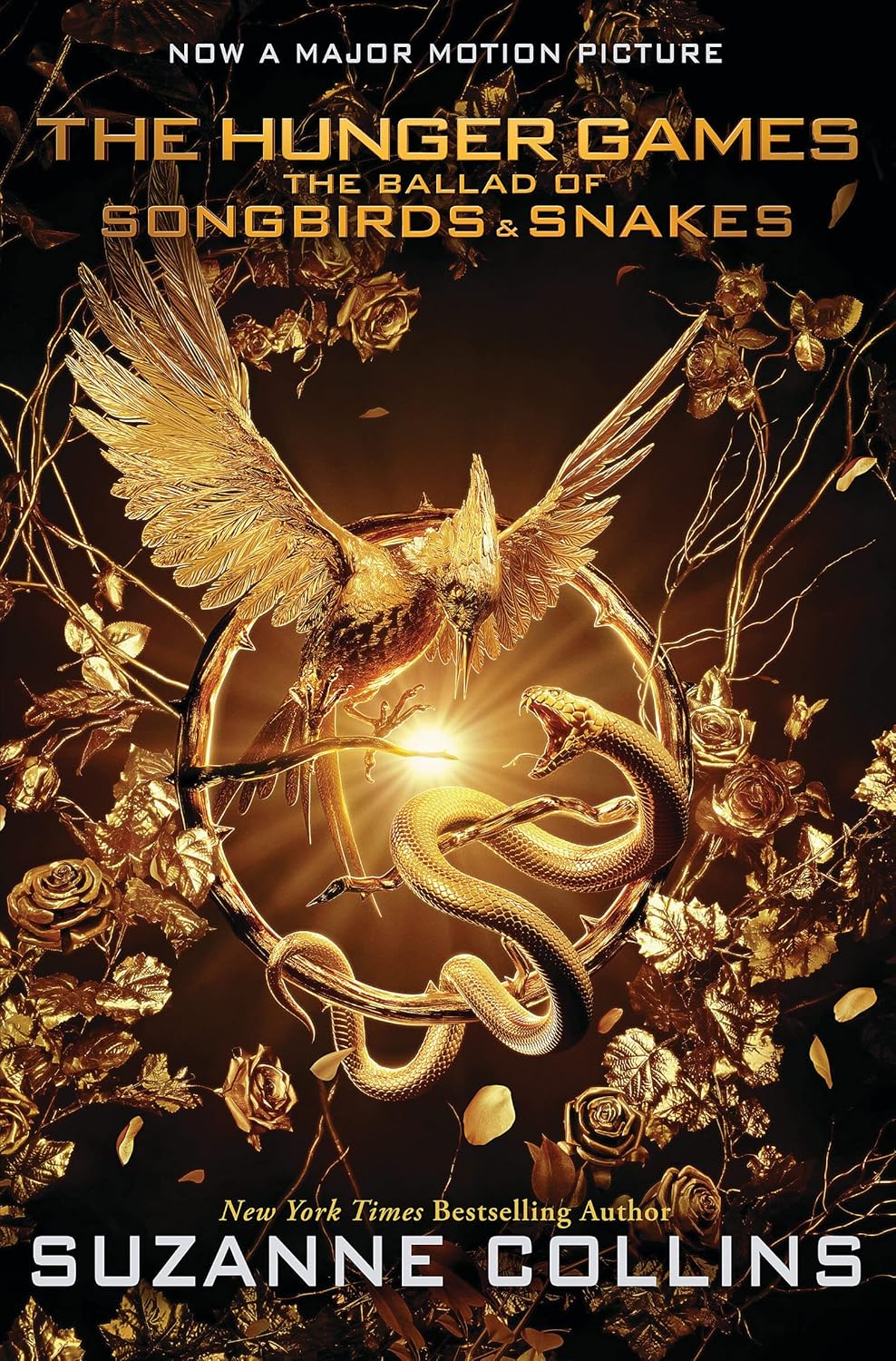
isbn-13: 9780702300189
Audible
AI Generated Content
Generated by gemini-3-pro-preview
Set sixty-four years before the events of The Hunger Games trilogy, The Ballad of Songbirds and Snakes functions as a prequel and a character study of the series’ primary antagonist, Coriolanus Snow. The narrative explores the sociopolitical landscape of Panem shortly after the “Dark Days”—the failed rebellion of the Districts against the Capitol. Unlike the technologically advanced and opulent Capitol seen in later books, this era is marked by reconstruction, scarcity, and the fledgling, brutal nature of the 10th Annual Hunger Games.
Story Arc and Plot Summary
The novel is structured into three distinct acts: “The Mentor,” “The Prize,” and “The Peacekeeper.”
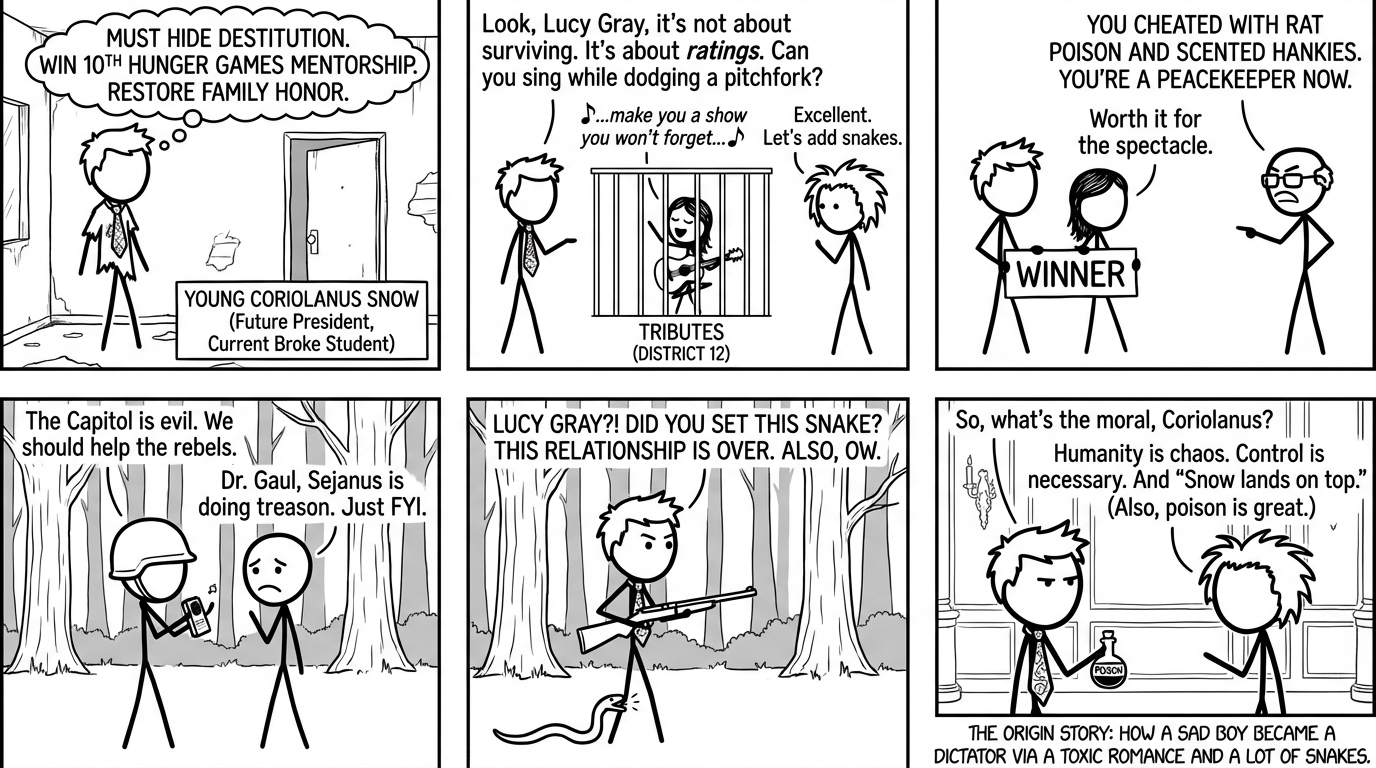
The story begins with eighteen-year-old Coriolanus Snow, who is outwardly a student of the Academy but privately struggling to maintain the appearance of wealth. The Snow family—comprising Coriolanus, his cousin Tigris, and his grandmother, the Grandma’am—is destitute, their fortune lost during the war. Coriolanus views the upcoming 10th Hunger Games as his only path to university and a restored reputation. For the first time, Academy students are assigned as mentors to the tributes to increase viewer engagement. Snow is assigned the female tribute from District 12, a charismatic performer named Lucy Gray Baird.
Unlike the warrior tributes of later years, the 10th Games are crude. Tributes are treated as prisoners of war, kept in a zoo, and starved. Snow realizes that to win, he must not only ensure Lucy Gray’s survival but also make the Games a spectacle. He introduces the concept of betting and sponsorship to the Head Gamemaker, Dr. Volumnia Gaul.
The narrative follows the mentorship, wherein Snow bonds with Lucy Gray, driven by a mix of genuine infatuation and possessive ambition. He cheats to aid her, providing her with a compact to carry rat poison and slipping a scent-laden handkerchief into a tank of genetically modified snakes to ensure they will not attack her in the arena. Lucy Gray wins the Games, but Snow’s deception is discovered by Dean Casca Highbottom, the creator of the Games.
As punishment, Snow is conscripted as a Peacekeeper and sent to District 12. There, he reunites with Lucy Gray and is joined by Sejanus Plinth, a former Academy classmate from a wealthy District 2 family who has joined the Peacekeepers out of moral conflict. In District 12, Snow navigates a complex dynamic of romance with Lucy Gray and duty to the Capitol. When Sejanus becomes involved in a rebel plot to help escapees flee north, Snow secretly records Sejanus’s plans and sends them to Dr. Gaul via jabberjay, resulting in Sejanus’s execution for treason.
The climax occurs in the wilderness. Snow and Lucy Gray attempt to run away together to escape the crackdown in District 12. However, upon finding hidden weapons that link Snow to a previous murder, paranoia sets in. Snow realizes that Lucy Gray is the only loose end tying him to his crimes. Their relationship dissolves into a hunt; Lucy Gray disappears, leaving a trap involving a snake that bites Snow, and Snow fires his rifle into the woods, though her fate is left ambiguous.
Snow returns to the Capitol, having been honorably discharged due to Dr. Gaul’s intervention. He is embraced as Gaul’s protégé, poisons Dean Highbottom, and sets himself on the path to becoming the tyrannical President Snow.
Character Development
- Coriolanus Snow: The narrative is strictly anchored in Snow’s perspective. Initially, he appears as a sympathetic underdog trying to survive poverty. However, Collins meticulously peels back these layers to reveal a narcissist who views love as a liability and people as possessions. His development is a descent into sociopathy. His internal monologue reveals that his actions, even those that appear benevolent, are calculated for self-preservation or advancement. He concludes that “what he needed was not a chaotic songbird, but a guide.”
- Lucy Gray Baird: A member of the Covey (a traveling musical group), Lucy Gray is a performer who understands how to manipulate an audience. She serves as a foil to Katniss Everdeen; where Katniss is a reluctant survivalist, Lucy Gray is a charming showwoman. She represents the “Songbird”—freedom, art, and unpredictability. Her character highlights Snow’s inability to control nature.
- Sejanus Plinth: Sejanus acts as the moral conscience of the novel. His empathy for the tributes and disdain for the Capitol’s brutality stand in stark contrast to Snow’s pragmatism. His death is the catalyst that solidifies Snow’s loyalty to the Capitol’s authoritarian order.
- Dr. Volumnia Gaul: The Head Gamemaker and a twisted mentor figure to Snow. She uses the Games as an experimental lab to prove her Hobbesian worldview: that humanity is inherently violent and requires a totalitarian state (the Capitol) to maintain order.
Themes and Messages
Spectacle and Media Manipulation:
The novel details the origin of the Games as a media event. It illustrates the transition from a mere execution of children to a televised entertainment product. Snow realizes that to keep the Districts in line and the Capitol engaged, the audience must care about the victims before watching them die. This theme critiques the consumption of violence as entertainment.
Control vs. Chaos:
The title references two opposing forces. Songbirds (Lucy Gray, the Mockingjays) represent uncontrollable nature, music, and civil disobedience. Snakes (Snow, Dr. Gaul) represent calculated control, poison, and authoritarianism. Snow’s hatred of the Mockingjays—birds that the Capitol failed to control—foreshadows his future conflicts. He desires a world where everything is structured and owned.
“Snow lands on top.” — The Snow family motto.
The Complexity of Evil:
Collins avoids presenting Snow as a monster from birth. Instead, she illustrates how a combination of trauma, societal pressure, and a series of moral compromises can construct a tyrant. Snow chooses power over love and order over morality, rationalizing his cruelty as necessary for the survival of civilization.
The book concludes by bridging the gap to the original trilogy, explaining the origins of specific elements such as the song “The Hanging Tree,” the hatred of Mockingjays, and the strategic use of food and poison as weapons of political control.