isbn-13: 9798220000000
Audible
AI Generated Content
Generated by gemini-3-pro-preview
Introduction
“The Next Conversation: Argue Less, Talk More” by Jefferson Fisher serves as a practical guide for navigating high-stakes and everyday interactions with the goal of reducing conflict and fostering genuine connection. Drawing on his background as a trial lawyer, Fisher challenges the conventional wisdom that conversations are battles to be won. He argues that the desire to “win” an argument often comes at the expense of the relationship, a cost that is rarely worth paying [1]. Instead, the book proposes a shift in perspective: effective communication is not about conquering an opponent but about self-regulation and intentionality.
The book is structured to help readers transform how they speak by first transforming how they think and feel during an interaction. Fisher provides actionable advice on how to maintain composure, speak with authority without aggression, and ultimately build bridges rather than burn them. It is a manual for those who wish to move from reactive arguments to proactive, meaningful dialogue.
Overview of the Key Points
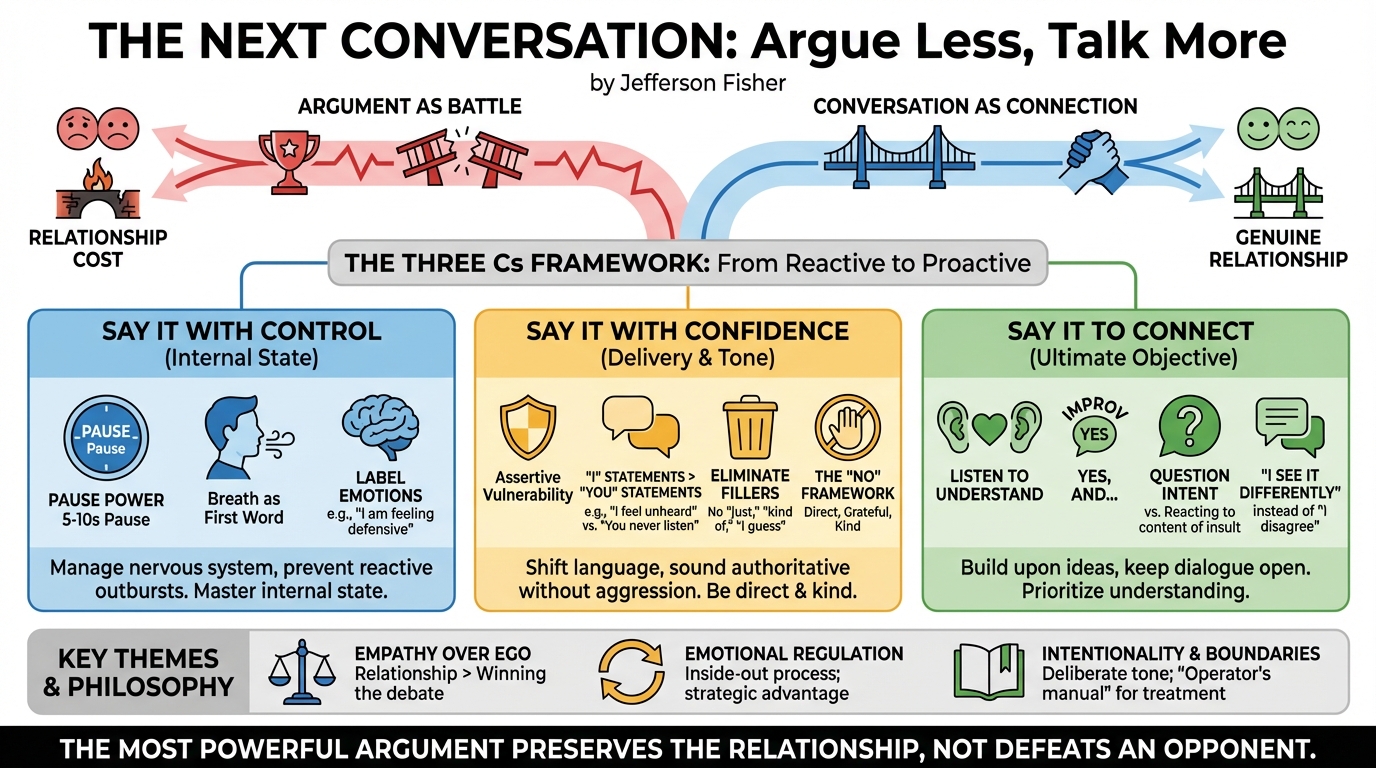
The core of Fisher’s methodology is built around a three-part framework known as the “Three Cs”: Control, Confidence, and Connection. Each section offers specific tools to handle difficult conversations.
Say it with Control
The first step in any difficult conversation is mastering one’s own internal state. Fisher emphasizes “Pause Power,” advising readers to take a 5-10 second pause before responding to heated comments. This brief interval allows for the nervous system to settle, preventing reactive outbursts [1]. He also advocates for using breath as the first word—stabilizing oneself physically before engaging verbally. Another critical technique is labeling emotions, such as admitting “I am feeling defensive,” which helps to manage feelings rather than letting them dictate the course of the discussion [1].
Say it with Confidence
Once control is established, the focus shifts to delivery. Fisher suggests replacing accusatory language with assertive vulnerability. This involves shifting from “You” statements (e.g., “You never listen”) to “I” statements (e.g., “I feel unheard”), which significantly reduces defensiveness in the other party [1]. To sound more authoritative, he advises eliminating filler words like “just,” “kind of,” or “I guess.” Additionally, the “No” Framework provides a method to decline requests clearly and kindly by being direct, showing gratitude, and maintaining a kind tone [1].
Say it to Connect
The ultimate objective is connection. Fisher encourages a mindset of listening to understand rather than listening to respond [3]. He borrows the “Yes, And” approach from improv comedy to build upon ideas rather than shutting them down with “but.” When faced with insults or rude behavior, he suggests asking questions of intent rather than reacting to the content of the insult, and using the phrase “I see it differently” instead of “I disagree” to keep the dialogue open [1].
Overview of the Key Themes
Empathy Over Ego
A recurring theme throughout the book is the suppression of the ego. Fisher posits that the need to be “right” is the enemy of connection. He urges readers to prioritize the health of the relationship over the momentary satisfaction of winning a debate [1].
Emotional Regulation
The book treats effective communication as an inside-out process. Fisher argues that while we cannot control what others say or do, we have absolute agency over our own reactions. Emotional regulation is portrayed not just as a coping mechanism, but as a strategic advantage in communication [3].
Intentionality and Boundaries
Every word matters in Fisher’s framework. He promotes being deliberate with tone and word choice, ensuring that the message received matches the intent [2]. Furthermore, setting boundaries is reframed not as an act of hostility, but as providing an “operator’s manual” for how one expects to be treated, which is essential for healthy long-term communication [1].
Conclusion
“The Next Conversation” offers a compelling alternative to the adversarial nature of modern discourse. Jefferson Fisher combines the tactical precision of a trial lawyer with the empathetic insight of a mediator to create a guide that is both strategic and humane. By mastering the “Three Cs”—Control, Confidence, and Connection—readers are equipped to handle even the most volatile conversations with grace. The book ultimately teaches that the most powerful argument is not the one that defeats an opponent, but the one that preserves the relationship.
Further Reading
- “Never Split the Difference” by Chris Voss: Written by a former FBI negotiator, this book focuses on high-stakes communication and specific phrasing techniques to de-escalate conflict, similar to Fisher’s approach.
- “Crucial Conversations” by Kerry Patterson, Joseph Grenny, Ron McMillan, and Al Switzler: A classic in the genre that provides a structural framework for handling high-stakes, emotional discussions.
- “Difficult Conversations: How to Discuss What Matters Most” by Douglas Stone, Bruce Patton, and Sheila Heen: Emerging from the Harvard Negotiation Project, this book shares the focus on shifting from a “message delivery” stance to a “learning” stance.
Sources
- [1] Goodreads: https://www.goodreads.com/book/show/215514806-the-next-conversation
- [2] eBay: https://www.ebay.com/itm/389262171918
- [3] Everand: https://www.everand.com/book/878422455/Summary-of-Jefferson-Fisher-s-The-Next-Conversation