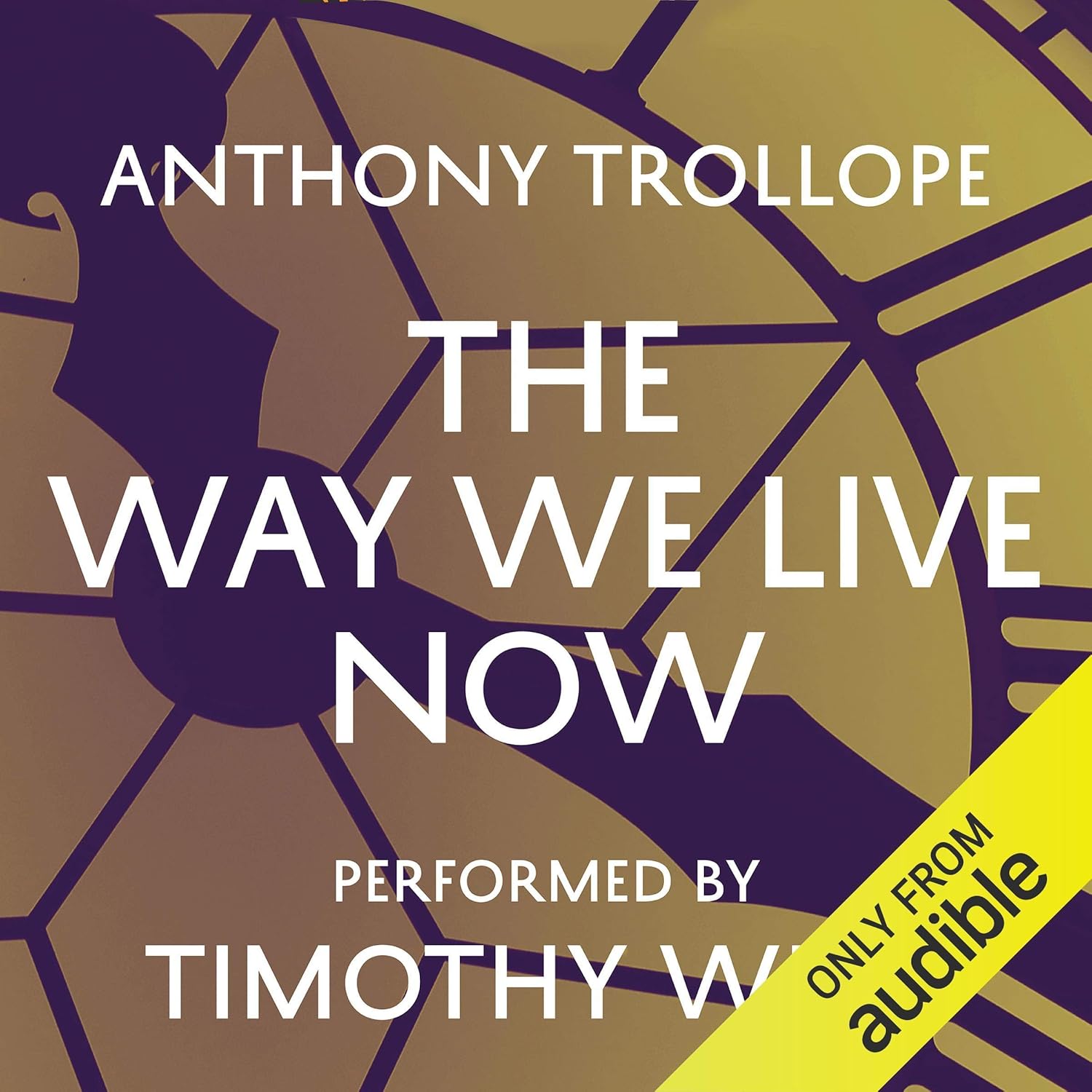
isbn-13: 9781427069405.0
Audible
AI Generated Content
Generated by gemini-3-pro-preview
Introduction
“The Way We Live Now” is a satirical novel by Anthony Trollope, first published in serial form between 1874 and 1875. Written shortly after Trollope’s return to England from abroad, the novel was born out of the author’s indignation at what he perceived as the moral decline of Victorian society. It serves as a scathing critique of the commercial profligacy and dishonesty that characterized the era’s financial and social interactions [1]. Often regarded as Trollope’s masterpiece, the work captures a specific historical moment dominated by speculative bubbles and the erosion of traditional values in favor of wealth and status [2].
Overview of the story
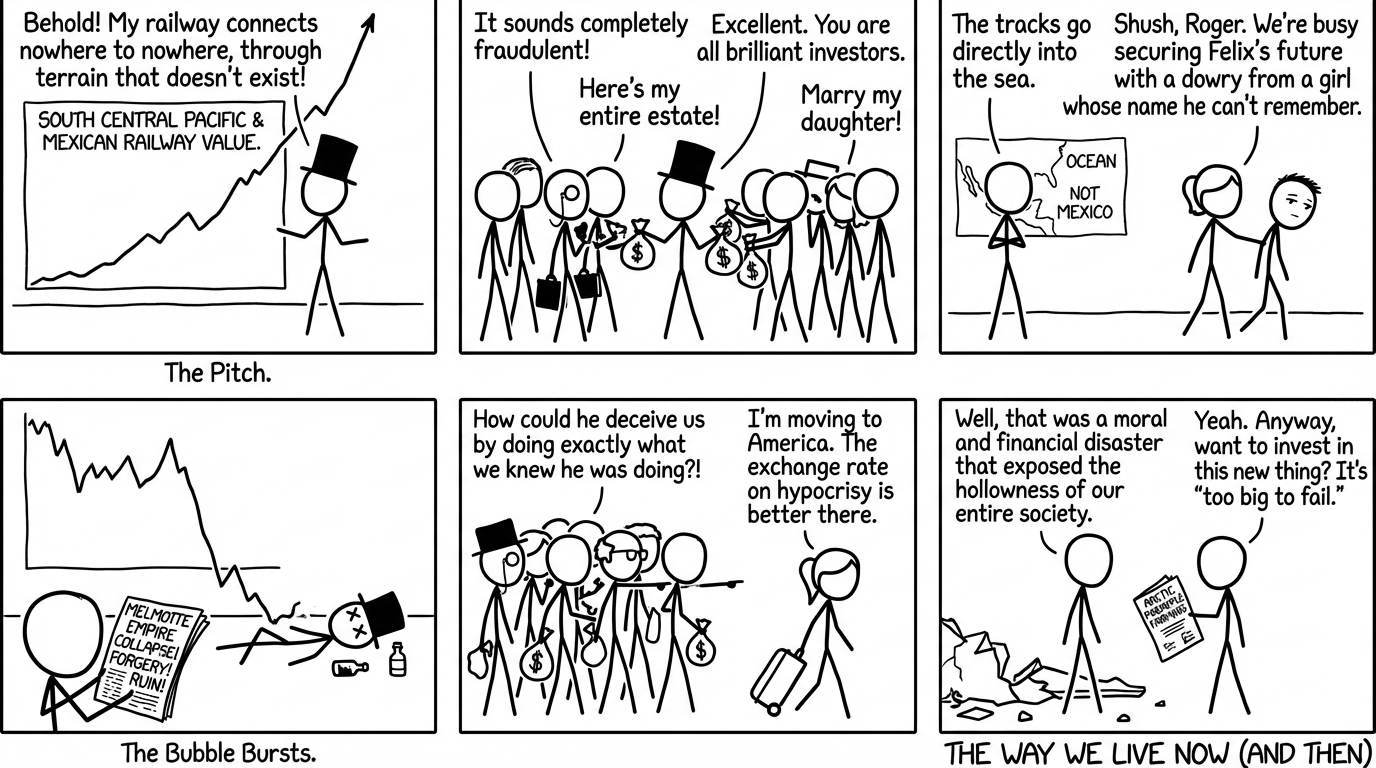
The narrative centers on the arrival of Augustus Melmotte in London, a financier of mysterious origins and rumored immense wealth. Melmotte establishes a company to construct the “South Central Pacific and Mexican Railway,” a grand but largely fraudulent enterprise. Despite widespread rumors of his dishonesty, the London social elite, desperate to fund their lavish lifestyles, flock to him. Melmotte’s ascent is rapid; he is elected to Parliament and even entertains the Emperor of China, symbolizing the complete submission of high society to the power of money [3].
Entwined with Melmotte’s rise is the story of the Carbury family. Lady Carbury, a struggling authoress who relies on charm rather than talent to sell her books, is devoted to her son, Sir Felix Carbury. Felix is a handsome but morally bankrupt idler who gambles away his mother’s resources at the “Beargarden” club. Lady Carbury schemes for Felix to marry Marie Melmotte, Augustus’s daughter, solely to secure her dowry. However, Felix’s laziness and incompetence lead to his failure to win Marie, and he is eventually exposed as a scoundrel [1].
Meanwhile, a romantic triangle develops involving Paul Montague, a young partner in Melmotte’s railway scheme who begins to suspect fraud. Paul is in love with Hetta Carbury, Lady Carbury’s daughter, but finds himself entangled with Mrs. Winifred Hurtle, an impetuous American widow with a violent past. Watching over these events is Roger Carbury, a country squire who represents traditional English integrity. Though he also loves Hetta, he ultimately steps aside to allow her to marry Paul, acting as the novel’s moral anchor [3].
The story culminates in the collapse of Melmotte’s financial empire. Exposed for forging signatures to access trust funds and abandoned by the society that once fawned over him, Melmotte commits suicide. In the aftermath, the characters face their respective fates: Marie Melmotte refuses to be a pawn and moves to America with her fortune; Sir Felix is ruined and exiled; and Paul and Hetta marry, securing a stable future under the protection of Roger Carbury [4].
Overview of the characters
Augustus Melmotte is the novel’s antagonist, a swindler of gigantic proportions whose greed and lack of scruples drive the plot. His obscure origins and meteoric rise mirror the financial instability of the period, representing the corrupting power of unchecked capitalism [2].
Lady Carbury is a pragmatic and manipulative matriarch who sacrifices everything for her worthless son. She represents the compromises made by the literary and social worlds, using connections and flattery to survive in a competitive environment [1].
Sir Felix Carbury personifies the moral decay of the younger generation. Beautiful but hollow, he feels entitled to wealth without work, relying on gambling and marriage schemes to support his dissipated lifestyle [4].
Roger Carbury serves as the moral compass of the book. As a traditional landowner, he embodies the virtues of “Old England”—honesty, duty, and stability—standing in stark contrast to the volatile and deceptive world of Melmotte [3].
Marie Melmotte, initially a passive figure, evolves into a hardened and independent woman. Realizing that her noble suitors are only interested in her money, she rejects the social climbing game entirely [1].
Paul Montague is a flawed but fundamentally decent character who struggles to extricate himself from both moral and romantic entanglements. His journey involves rejecting the easy wealth of Melmotte’s scheme and the chaotic passion of Mrs. Hurtle in favor of an honest life with Hetta [3].
Overview of the themes
Greed and Corruption permeate the novel, illustrated by the aristocracy’s willingness to debase themselves for Melmotte’s money. Trollope satirizes a society where wealth has replaced honor as the ultimate measure of worth, and where speculative bubbles are embraced despite their obvious risks [2].
The Marriage Market is depicted as a cynical business exchange rather than a romantic union. Characters like Georgiana Longestaffe and Sir Felix Carbury view marriage strictly as a means to acquire financial security or social status, highlighting the commodification of personal relationships [1].
Anti-Semitism is a complex theme within the book. While the villainous Melmotte is rumored to be Jewish, Trollope creates a counterpoint in Mr. Brehgert, a Jewish banker who acts with honor and dignity. The prejudice Brehgert faces from the foolish Christian aristocracy serves to critique their hypocrisy rather than validate their bigotry [3].
Old vs. New contrasts the traditional, landed gentry represented by Roger Carbury with the new, chaotic force of international finance. This tension underscores the anxiety of the Victorian era regarding the displacement of established social orders by modern commercialism [4].
Conclusion
“The Way We Live Now” remains a powerful indictment of a society losing its moral bearings in the pursuit of wealth. By weaving together the fates of aristocrats, financiers, and writers, Trollope creates a comprehensive panorama of Victorian London that exposes the hollowness of a culture built on speculation and pretense. The novel concludes with a restoration of order, but the scars left by Melmotte’s influence serve as a lasting warning against the abandonment of integrity for the sake of “the way we live now.”
Sources
[1] eNotes Study Guide: https://www.enotes.com/topics/way-we-live-now [2] The Victorian Web: https://victorianweb.org/authors/trollope/wwlnov.html [3] Less Than A Megabyte (Blog): https://lessthanamegabyte.wordpress.com/anthony-trollope-the-way-we-live-now/ [4] Project Gutenberg: https://www.gutenberg.org/ebooks/5231