
isbn-13: 9780063396029
Audible
AI Generated Content
Generated by gemini-3-pro-preview
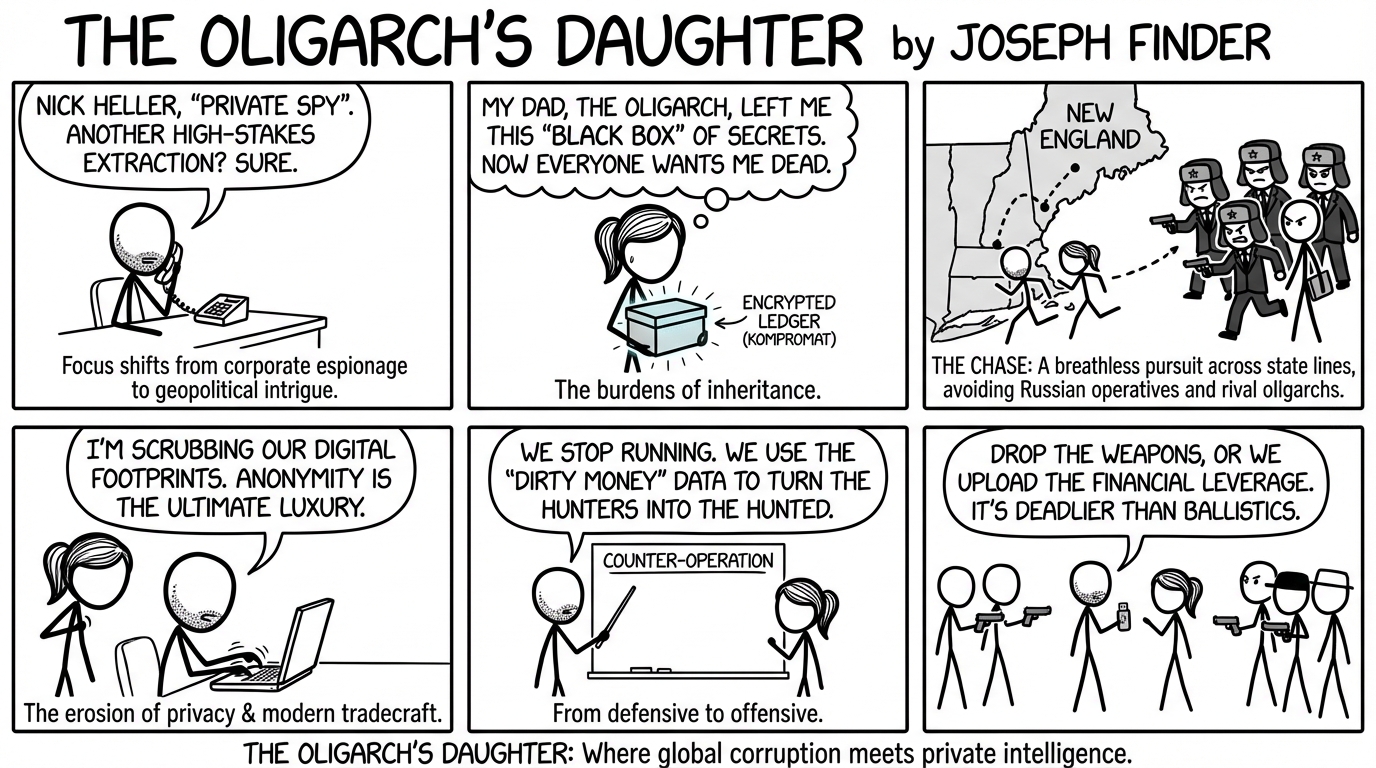
The Oligarch’s Daughter, the fifth installment in the Nick Heller series by Joseph Finder, marks the return of the Boston-based “private spy.” Published by HarperCollins, the novel shifts focus from the corporate espionage typical of previous entries toward geopolitical intrigue, centering on the collision between American private interests and Russian organized crime.
Story Arc and Plot Summary
The narrative begins with a high-stakes extraction. Nick Heller is hired to protect Paulina Ivanova, a young woman living in the United States who finds herself the target of lethal professionals following the suspicious death of her father. Her father, a prominent Russian oligarch formerly aligned with the Kremlin, recently died under mysterious circumstances—falling from a window in Moscow—leaving Paulina as the sole possessor of a dangerous secret.
Unlike a standard kidnapping case, the situation is complicated by what Paulina carries. She holds an encrypted digital ledger, a “black box” of financial secrets and kompromat (compromising material) that outlines the illicit wealth and leverage her father hoarded. This information makes her a target not only of rival oligarchs looking to seize the assets but also of Russian intelligence operatives intent on burying the secrets permanently.
The story unfolds as a breathless chase across New England and the Mid-Atlantic. Heller must utilize his specialized skill set—ranging from physical combat to high-tech surveillance and social engineering—to keep Paulina off the grid. The narrative arc moves from a defensive posture, where Heller and Paulina are constantly reacting to ambushes, to an offensive strategy. Realizing they cannot run indefinitely, Heller orchestrates a complex counter-operation designed to turn the hunters into the hunted, leveraging the very information the antagonists seek to destroy them. The climax involves a tense confrontation where financial leverage proves as deadly as ballistics.
Character Development
Nick Heller Heller remains the anchor of the series, characterized by his background in Special Forces and his cynical yet rigid moral code. In this installment, Finder emphasizes Heller’s resourcefulness over brute strength. He is depicted not as a superhero, but as a pragmatic operator who relies on preparation and intelligence. The novel explores his weariness with the corruption he encounters, yet reinforces his compulsion to aid those who cannot help themselves. His relationship with Paulina challenges his professional detachment, forcing him to navigate the line between asset protection and personal empathy.
Paulina Ivanova Paulina serves as the catalyst for the plot but is developed beyond a mere MacGuffin. Initially presented as a terrified victim of circumstance, she reveals layers of competence and resilience. Having grown up adjacent to ruthless power, she possesses an intuitive understanding of the enemy’s mindset. Her development centers on her transition from a passive figure fleeing her father’s legacy to an active participant in dismantling the forces threatening her.
The Antagonists The opposition is represented by a mix of efficient Russian operatives and American enablers. Rather than cartoonish villains, Finder portrays them as corporate professionals of violence—bureaucratic, methodical, and financially motivated. This grounding keeps the threat level realistic and consistent with the book’s tone.
Themes and Messages
The Long Arm of the Oligarchy The primary theme is the permeability of national borders when it comes to illicit finance and power. Finder illustrates how Russian volatility can bleed into American life, suggesting that in a globalized economy, no one is truly isolated from foreign corruption. The novel examines how “dirty money” is laundered through legitimate Western institutions, implicating the systems that allow oligarchs to operate globally.
Surveillance and Privacy Consistent with the series’ focus, the book explores the erosion of privacy. Heller’s tradecraft highlights how easily individuals can be tracked through digital footprints, facial recognition, and data mining. The narrative suggests that in the modern era, anonymity is the ultimate luxury—and the hardest to maintain.
Legacy and Sins of the Father The title refers not just to Paulina’s identity, but to the burden of inheritance. The story questions whether a child can escape the moral debts of a parent. Paulina’s struggle is not just for physical survival, but for the freedom to define herself outside the shadow of her father’s corruption.
Style and Tone
Finder employs a lean, journalistic prose style. The pacing is rapid, utilizing short chapters and alternating perspectives to maintain tension. The tone is objective and grounded in tradecraft realism; the author prioritizes the mechanics of espionage—how to sweep a room for bugs, how to execute a counter-surveillance route—over melodramatic action sequences. The dialogue is functional and sharp, often serving to advance the plot or reveal tactical information.
The Oligarch’s Daughter functions as a procedural thriller that merges the specific mechanics of private intelligence with the broader anxieties of modern geopolitical conflict.