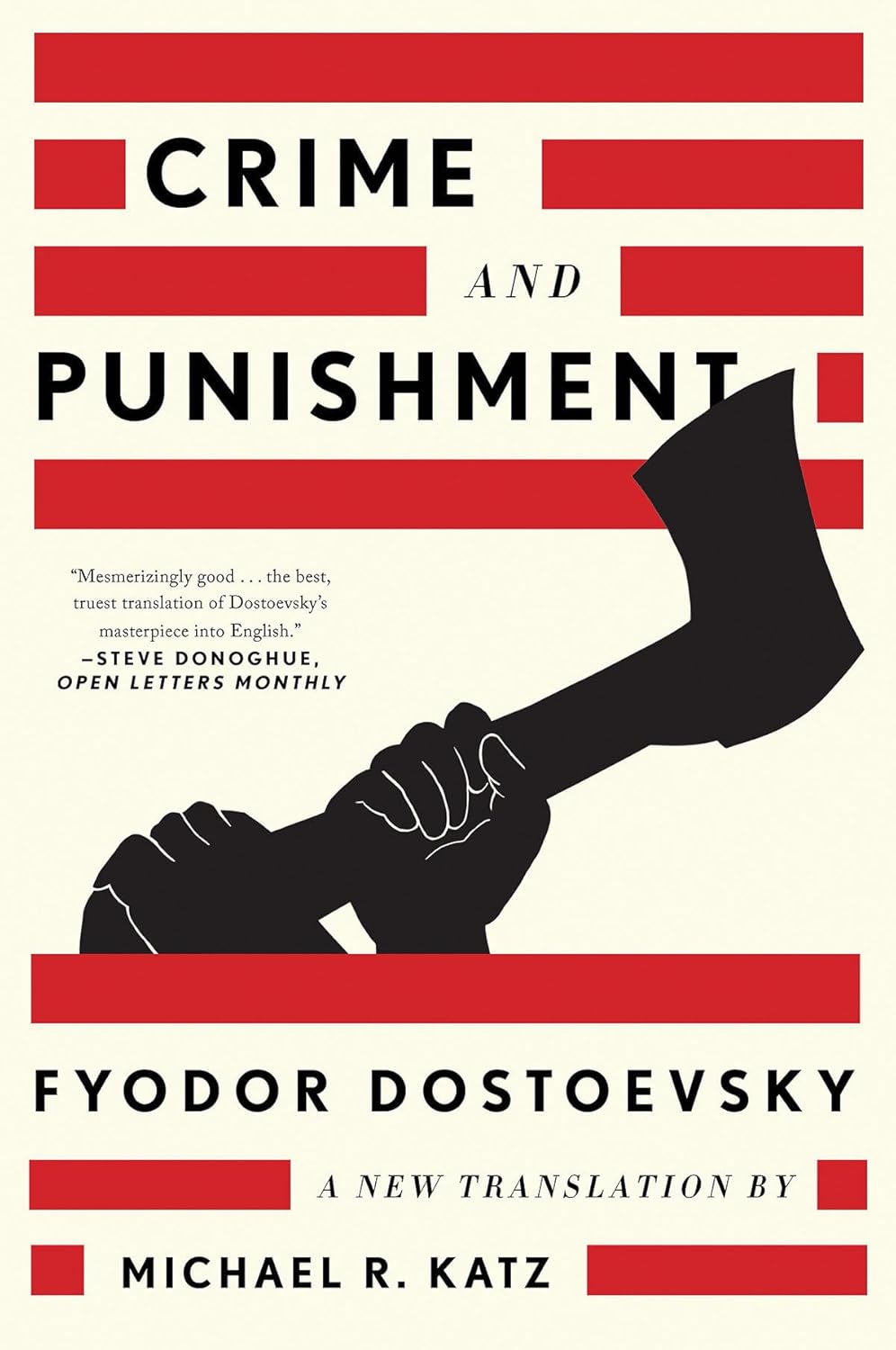
isbn-13: 978-1631495311
Audible
AI Generated Content
Generated by gemini-3-pro-preview
Introduction
Crime and Punishment, first published in twelve monthly installments in the literary journal The Russian Messenger in 1866, stands as one of the definitive works of Russian literature. Written by Fyodor Dostoevsky during a period of immense social and political upheaval following the emancipation of the serfs, the novel reflects the chaotic ideological landscape of 19th-century Russia. This 1914 translation by Constance Garnett played a pivotal role in introducing Dostoevsky to the Western world, offering a smooth, Victorian prose style that, while occasionally smoothing over the author’s rougher edges, was adored by early modernists like Ernest Hemingway [1][4].
Set in the sweltering, claustrophobic atmosphere of St. Petersburg, the novel serves as a critique of radical new theories such as “Nihilism” and “Utilitarianism” that were gaining traction at the time. It is widely considered one of the first psychological novels, marking a significant shift in literature by focusing less on the external details of a crime and more on the internal, spiritual torment of the criminal [3].
Overview of the story
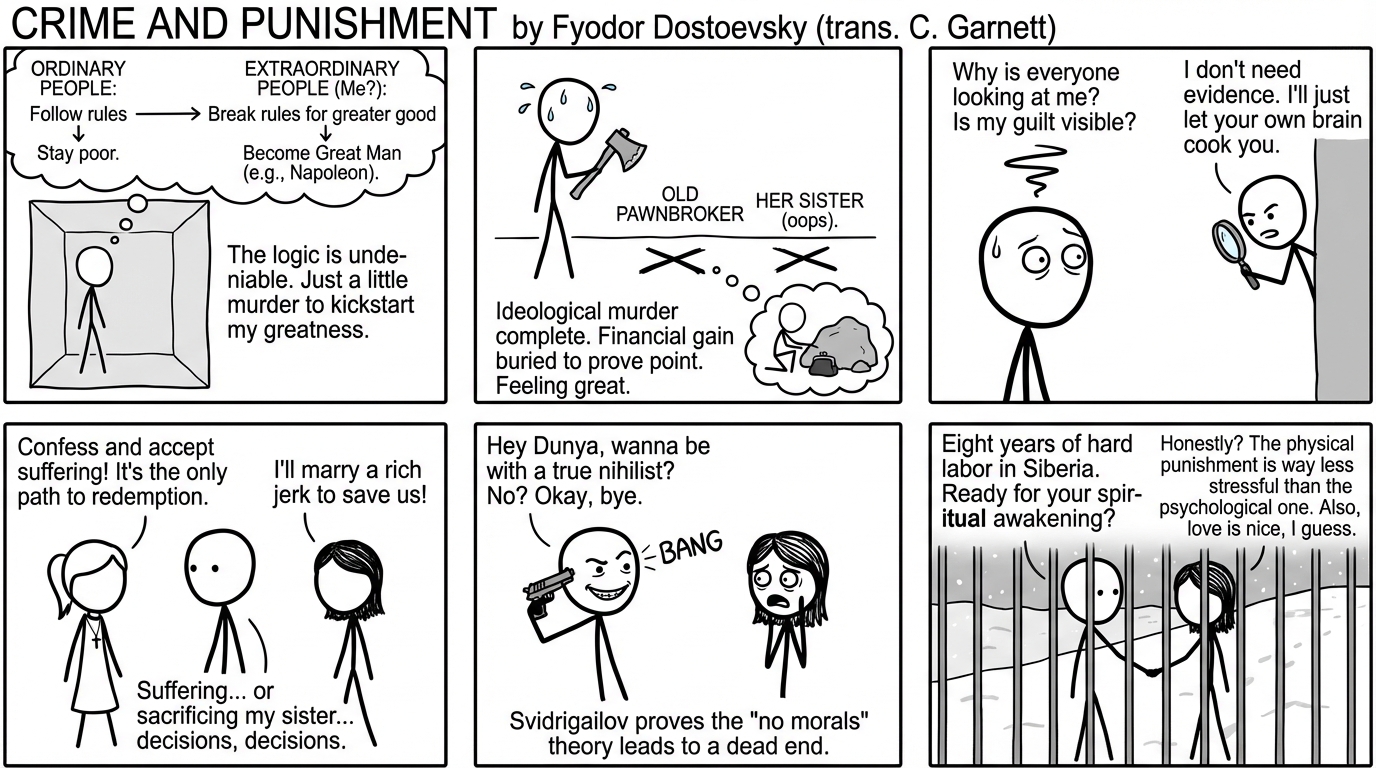
The narrative follows Rodion Romanovich Raskolnikov, a destitute former student living in a tiny, coffin-like garret in St. Petersburg. Driven by poverty and a feverish belief in a “Superman” theory—that extraordinary individuals have the right to transgress moral laws for the greater good—he brutally murders an unscrupulous elderly pawnbroker, Alyona Ivanovna, with an axe. In the panic of the act, he is forced to also kill her gentle, innocent sister, Lizaveta, who stumbles upon the scene. Raskolnikov steals a small purse and trinkets but buries them under a rock without ever using them, proving to himself that his motivation was ideological rather than financial [5].
Following the murder, the novel details the intense psychological cat-and-mouse game that ensues. Raskolnikov descends into a delirious state, oscillating between arrogance and paranoia. He is pursued by the cunning investigator Porfiry Petrovich, who suspects Raskolnikov but lacks concrete proof, relying instead on psychological pressure to force a confession. As Raskolnikov becomes increasingly isolated by his guilt, he finds himself drawn to Sonya Marmeladov, a young woman forced into prostitution to support her starving family. Meanwhile, his sister Dunya arrives in the city, pursued by two suitors: the wealthy, calculating Luzhin and the depraved Svidrigailov [2][5].
The pressure mounts until Svidrigailov, who knows Raskolnikov’s secret, commits suicide after being rejected by Dunya. Realizing his theory has failed because he is crushed by guilt—proving he is “ordinary”—Raskolnikov visits Sonya. She urges him to confess and “accept his suffering” to achieve redemption. In the epilogue, Raskolnikov confesses and is sentenced to eight years of hard labor in Siberia. Sonya follows him, and it is there, after a long period of spiritual resistance, that he finally undergoes an awakening, realizing that love and humility offer the only true path to life [5].
Overview of the characters
- Rodion Raskolnikov: The protagonist is an impoverished, intelligent, but arrogant former student. He is a character of extremes, capable of great charity and brutal violence. He represents the dangers of intellect detached from morality, serving as the vessel for Dostoevsky’s critique of rationalism [2].
- Sonya Marmeladov: The daughter of a drunkard, she is the moral center of the book. despite her profession, she represents meekness, self-sacrifice, and Christian love. She serves as the catalyst for Raskolnikov’s eventual redemption, offering a path of suffering rather than suicide [2].
- Avdotya (Dunya) Romanovna: Raskolnikov’s intelligent and proud sister. She mirrors her brother’s willingness to sacrifice herself, intending to marry the wealthy Luzhin to save her family from poverty—a sacrifice Raskolnikov violently rejects [2].
- Arkady Svidrigailov: Dunya’s former employer and a wealthy, depraved nihilist. He acts as a dark “double” to Raskolnikov, showing the end result of a man who has truly “stepped over” all moral lines. His path leads only to emptiness and suicide [2].
- Porfiry Petrovich: The sharp investigator who understands Raskolnikov’s psyche perfectly. He acts as both a tormentor and a mentor, urging Raskolnikov to confess not just to solve the case, but to save his own soul [2].
- Dmitri Razumihin: Raskolnikov’s loyal friend. He serves as a foil to the protagonist—though also poor and struggling, he remains cheerful, hardworking, and connected to humanity [2].
Overview of the themes
The novel explores several profound themes, most notably the “Superman” (Übermensch) theory. Raskolnikov’s central idea that great men are above moral law is systematically dismantled, showing that such isolation leads to madness rather than greatness. Dostoevsky uses this to critique the Nihilism and Utilitarianism of 1860s Russian radicalism, arguing that logic alone cannot justify human actions and often leads to monstrous conclusions [3].
Alienation is another central theme; the act of murder physically and spiritually separates Raskolnikov from humanity. He finds he cannot endure the company of his mother or sister while carrying his secret. Reconnection is only possible through confession and the acceptance of punishment. This ties into the theme of redemption through suffering, a distinctly Russian Orthodox concept. The “punishment” in the title refers less to the legal prison sentence and more to the internal psychological disintegration that precedes it. Raskolnikov cannot simply be “rehabilitated”; he must suffer to purge his guilt, a path illuminated by Sonya [3].
Conclusion
Crime and Punishment fundamentally changed the landscape of literature by placing the reader directly inside the criminal’s mind. It laid the groundwork for Existentialism, influencing thinkers like Friedrich Nietzsche and Albert Camus [6]. Its deep exploration of the psychology of crime, the limits of rationalism, and the possibility of redemption has cemented its status as a timeless classic. It remains a definitive argument that human nature cannot be reduced to mathematical formulas, and that the path to salvation often lies through suffering [3].
Sources
- [1] Goodreads: https://www.goodreads.com/book/show/63894969
- [2] GradeSaver: https://www.gradesaver.com/crime-and-punishment/study-guide/character-list
- [3] Psychiatry & Psychotherapy Podcast: https://www.psychiatrypodcast.com/psychiatry-psychotherapy-podcast/episode-128-dostoevsky-crime-and-punishment
- [4] TranslateOT: https://translateot.wordpress.com/2016/07/30/literary-translation-tale1/
- [5] LitCharts: https://www.litcharts.com/lit/crime-and-punishment/summary
- [6] The Montreal Review: https://www.themontrealreview.com/Articles/The_Appearance_of_Justice.php