
isbn-13: 9781669366751
Audible
AI Generated Content
Generated by gemini-3-pro-preview
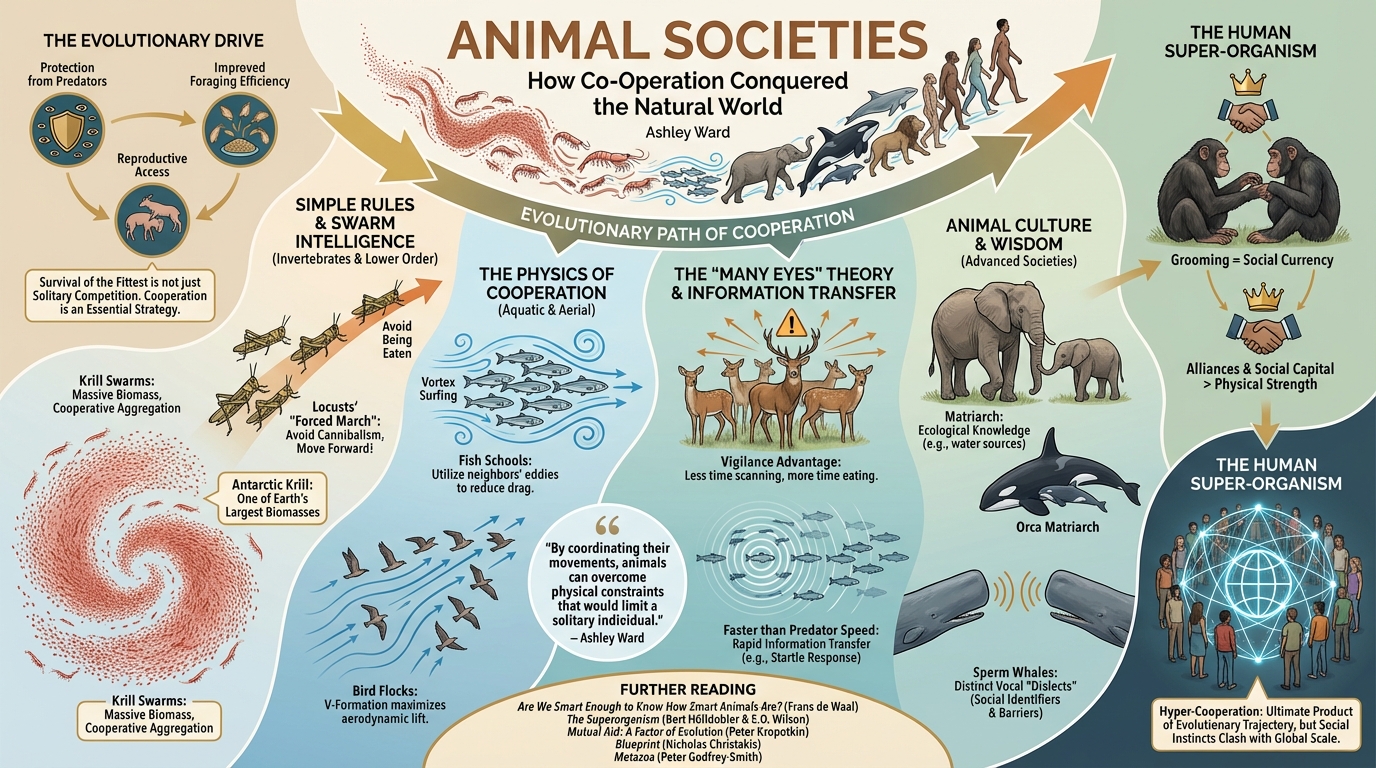
Animal Societies: How Co-Operation Conquered the Natural World by Ashley Ward examines the evolutionary history and biological mechanics of social living. Ward, a professor of animal behavior, moves taxonomically and conceptually from the simplest aggregations of invertebrates to the complex societal structures of primates and humans. The book challenges the view that evolution is driven solely by unbridled competition, arguing instead that cooperation is a dominant and essential survival strategy across the animal kingdom.
Key Points
The Evolutionary Drive for Togetherness
Ward posits that while the “survival of the fittest” often suggests solitary competition, social living offers distinct evolutionary advantages, primarily protection from predators, improved foraging efficiency, and reproductive access. He traces the origins of social behavior back to simple chemical signals in single-celled organisms.
Swarm Intelligence and Simple Rules
The book details how complex group behaviors in lower-order animals, such as krill and locusts, emerge from individuals following simple local rules rather than central leadership.
- In the case of locusts, swarming is driven partly by a “forced march” induced by cannibalism; individuals move forward to avoid being eaten by the locusts behind them.
- Ward highlights the Antarctic krill, noting that their massive swarms constitute one of the largest biomasses on the planet, demonstrating the success of cooperative aggregation.
The Physics of Cooperation
In aquatic and aerial environments, animals like fish and birds utilize physics to conserve energy. Fish schools utilize “vortex surfing,” riding the eddies created by their neighbors to reduce drag. Similarly, bird flocks use V-formations to maximize aerodynamic lift.
“By coordinating their movements, animals can overcome physical constraints that would limit a solitary individual.” (Context: Discussion on the hydrodynamics of fish schools).
The “Many Eyes” Theory
A recurring theme is the vigilance advantage. In groups, individuals can spend less time scanning for predators and more time eating. Information transfer—such as a startle response—moves through a school of fish or flock of birds faster than the speed of a predator.
Animal Culture and Wisdom
Ward argues that “culture”—defined as information transmitted socially rather than genetically—exists in advanced animal societies.
- Elephants and Orcas rely on matriarchs who hold ecological knowledge (e.g., location of water sources during droughts).
- Sperm whales possess distinct vocal “dialects” specific to their clans, which serve as social identifiers and barriers, preventing interbreeding between different cultural groups.
Hierarchy and Politics in Primates
The book explores the shift from instinctive herding to calculated politics. In primate societies, physical strength is often less important than social capital. Grooming serves as a currency to build alliances, reduce tension, and secure position within the hierarchy.
The Human Super-Organism
The final section addresses human society. Ward argues that humans are the ultimate product of this evolutionary trajectory. While humans share the basic instincts of other social animals (tribalism, hierarchy), language and global connectivity have allowed for “hyper-cooperation.” However, the book notes that our social instincts, evolved for small groups, often clash with the scale of modern global society.
Further Reading
- Are We Smart Enough to Know How Smart Animals Are? by Frans de Waal
- The Superorganism: The Beauty, Elegance, and Strangeness of Insect Societies by Bert Hölldobler and E.O. Wilson
- Mutual Aid: A Factor of Evolution by Peter Kropotkin
- Blueprint: The Evolutionary Origins of a Good Society by Nicholas Christakis
- Metazoa: Animal Life and the Birth of the Mind by Peter Godfrey-Smith