isbn-13: 9798726313092
Paperback
AI Generated Content
Generated by gemini-3-pro-preview
Introduction
“Lord Arthur Savile’s Crime: A Study of Duty” is a short story by Oscar Wilde, first published in The Court and Society Review in 1887 and later collected in the 1891 anthology Lord Arthur Savile’s Crime and Other Stories [1]. This work is a quintessential example of Wilde’s celebrated wit and satirical style, blending elements of mystery, social comedy, and Gothic fiction. Wilde subverts traditional Victorian moral values by presenting murder not as a heinous sin or a source of guilt, but as a tiresome social obligation that must be discharged to maintain propriety. The narrative treats the act of killing with a paradoxical banality, focusing on the protagonist’s anxiety over the timing and method rather than the morality of the deed itself [2].
Overview of the story
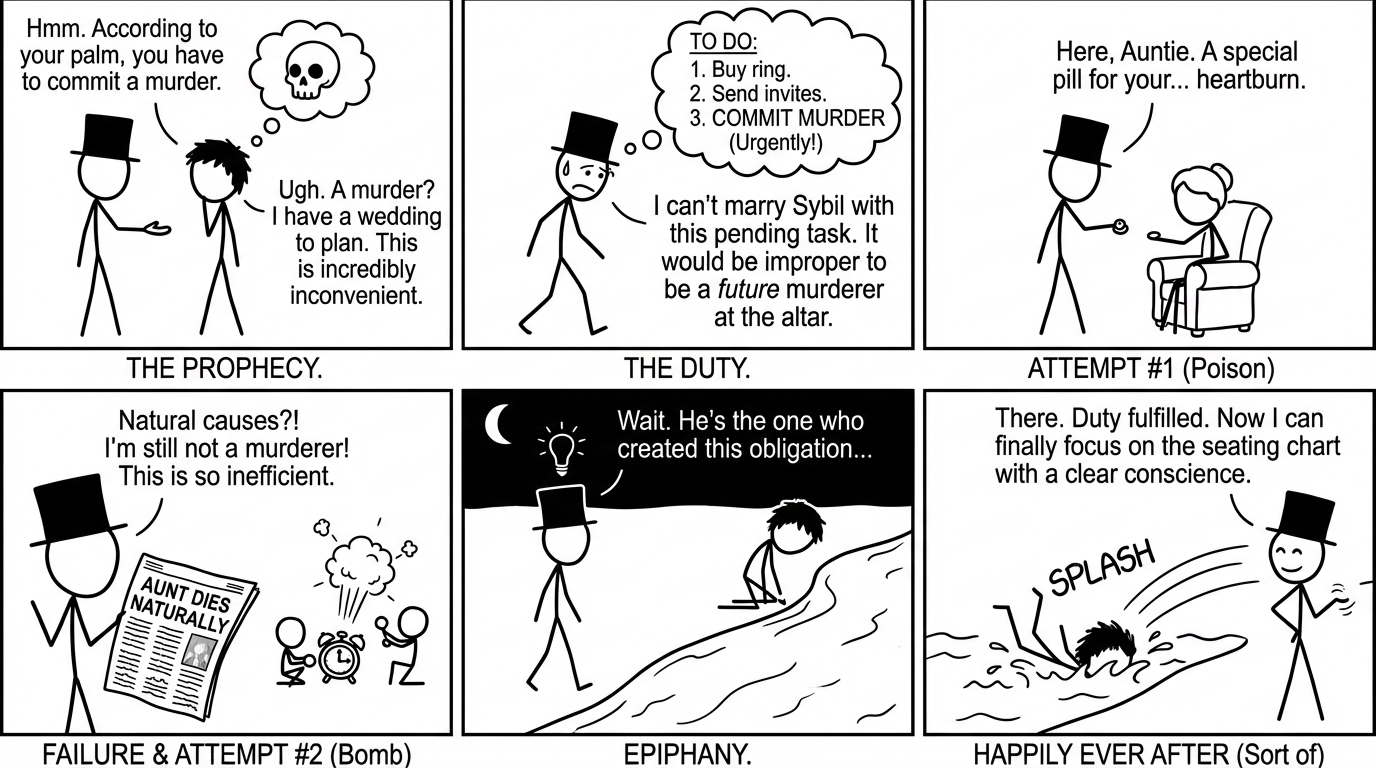
The narrative begins at a reception hosted by Lady Windermere, where she introduces her guests to Mr. Septimus R. Podgers, a “cheiromantist” or palm reader. Podgers impresses the guests with his insights, but when he examines the hand of young Lord Arthur Savile, he becomes visibly distressed. Privately, Lord Arthur bribes Podgers to reveal the truth, and the palm reader reluctantly predicts that Arthur is destined to commit a murder [1].
Terrified by this prophecy, Lord Arthur wanders the streets of London. His fear, however, is not rooted in the immorality of taking a life, but in the potential social disgrace and the burden of having such a duty hanging over him. He is engaged to the innocent Sybil Merton and decides he cannot marry her until he has fulfilled this destiny, reasoning that it would be dishonorable to burden his future wife with the shadow of a future crime. He resolves to commit the murder immediately to clear the way for his marriage [1].
His first target is a distant relative, Lady Clementina Beauchamp. He gifts her a poisoned pill, ostensibly as a cure for heartburn, and departs for Venice believing the deed is done. Upon his return, he learns of her death and feels relief, only to later discover the pill untouched among her effects, revealing she died of natural causes. Distraught that he is “not yet a murderer,” Arthur attempts a second murder, targeting his uncle, the Dean of Chichester. He sends an anonymous explosive clock to the Deanery, but the bomb fails to detonate properly and merely becomes a novelty toy for the Dean’s children [1].
Plunged into despair and believing he has failed his duty, Lord Arthur wanders by the Thames at night. By chance, he spots Mr. Podgers leaning over the embankment. In a sudden moment of inspiration, he pushes the cheiromantist into the river, where he drowns. The death is ruled accidental, and Lord Arthur, having finally fulfilled the prophecy, feels a profound sense of relief and accomplishment. He marries Sybil, and the story concludes with them living a happy life, with Arthur secretly attributing his domestic bliss to the successful completion of his “duty” [1].
Overview of the characters
Lord Arthur Savile serves as the protagonist and a satirical subversion of the traditional hero. He is wealthy, well-meaning, and deeply committed to what he perceives as his duty. However, his sense of duty is entirely divorced from universal morality. He views the murder he must commit as an administrative task—a “check” to be cashed—rather than a moral atrocity. His character critiques the superficiality of an upper class that prioritizes form and social obligation over genuine ethics [2].
Mr. Septimus R. Podgers is the cheiromantist who sets the plot in motion. Described as physically unappealing, he holds sway over the superstitious upper class. He represents the charlatanism that often fascinated Victorian society. His death at the hands of Lord Arthur is the story’s ultimate irony: by predicting the murder, he unwittingly identifies himself as the victim [1].
Lady Windermere is a prominent society hostess who treats people and their talents as mere amusements. She flits from one fad to another, representing the frivolous and transient nature of high society interests.
Sybil Merton is Lord Arthur’s fiancée, representing idealized, passive innocence. She is the unaware motivation for Arthur’s actions; his twisted logic dictates that he must become a murderer to protect her purity [2].
Overview of the themes
Duty vs. Morality is the central theme of the story. Wilde inverts the Victorian obsession with duty by applying it to a criminal act. Lord Arthur suffers no pangs of conscience regarding the act of murder itself; his anxiety is entirely focused on the social inconvenience of the prophecy. The subtitle, “A Study of Duty,” highlights this satire, presenting a protagonist whose conscience is perfectly clear provided he adheres to his own warped code of conduct [2].
Fate vs. Free Will is explored through the concept of the self-fulfilling prophecy. Lord Arthur believes he is a victim of an inescapable fate, yet he uses his free will to actively engineer that fate. Paradoxically, by trying to control his destiny and “get it over with,” he enslaves himself to the prediction made by Podgers [2].
The Satire of Social Class permeates the narrative. Wilde mocks the aristocracy for their trivial concerns and moral vacuity. In this world, murder is treated with the same casual annoyance as a breach of etiquette. The characters are obsessed with the appearance of propriety, rendering them blind to the absurdity of their actions [3].
Conclusion
“Lord Arthur Savile’s Crime” stands as a significant work in Oscar Wilde’s bibliography, bridging the gap between his earlier journalism and his later, more famous plays. While contemporary reception was mixed, with some critics finding the story simplistic compared to his dramatic works, modern criticism acknowledges it as a masterful synthesis of social satire and Gothic conventions [3]. The story remains a celebrated example of Wilde’s ability to expose the absurdities of social convention through paradox, humor, and the inversion of moral norms.
Sources
- [1] SuperSummary: Lord Arthur Savile’s Crime Summary and Study Guide: https://www.supersummary.com/lord-arthur-saviles-crime/summary/
- [2] SuperSummary: Lord Arthur Savile’s Crime Themes: https://www.supersummary.com/lord-arthur-saviles-crime/themes/
- [3] eNotes: Oscar Wilde Lord Arthur Savile’s Crime and Other Stories Criticism: https://www.enotes.com/topics/oscar-wilde-lord-arthur-saviles-crime-and-other/criticism