isbn-13: 9780593236192
Audible
AI Generated Content
Generated by gemini-3-pro-preview
Introduction
“Mindreader: The New Science of Deciphering What People Really Think, What They Really Want, and Who They Really Are” by David J. Lieberman explores the field of “psycholinguistics” to help readers understand the thoughts and intentions of others [1]. Moving beyond traditional body language analysis, which Lieberman argues can be easily manipulated, this book focuses on the spoken and written word as a more reliable window into the subconscious [2]. Lieberman, a psychotherapist and instructor for U.S. law enforcement agencies, presents methods for detecting deception and assessing mental health by analyzing grammatical structures and word choices [3].
Overview of the Key Points
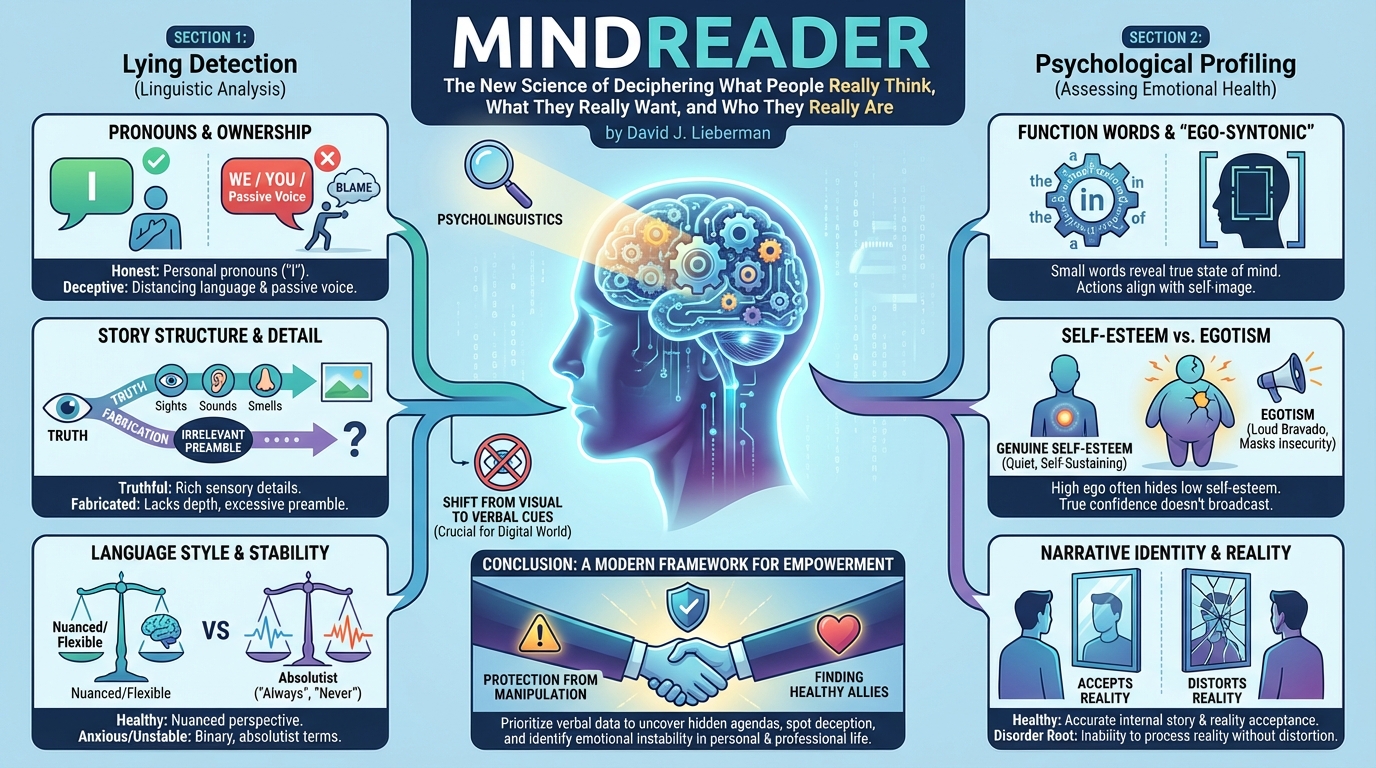
The book is structured around two primary objectives: lie detection and psychological profiling. A central component of Lieberman’s approach is the analysis of “function words”—such as pronouns, prepositions, and articles—which research suggests can reveal a speaker’s true state of mind [1].
Linguistic Analysis and Lie Detection
Lieberman details several specific linguistic markers that indicate deception. One such marker is the use of pronouns; honest individuals typically use personal pronouns like “I” to take ownership of their actions, whereas those concealing the truth often use “distancing language,” such as “we” or “you,” to psychologically separate themselves from their statements [1]. Additionally, the use of passive voice (e.g., “mistakes were made” rather than “I made a mistake”) is highlighted as a common tactic to deflect responsibility [1].
Another key technique involves analyzing the structure of a story. Truthful narratives usually contain rich sensory details—sights, sounds, and smells—whereas fabricated stories often lack this depth or focus excessively on irrelevant preamble to distract the listener [1]. The book also warns against “absolutist” language; the frequent use of binary terms like “always,” “never,” or “everyone” can indicate anxiety or emotional instability, as opposed to the nuanced perspective of a healthy mind [1].
Assessing Emotional Health
Beyond spotting lies, the book provides tools for evaluating long-term personality traits. Lieberman introduces the concept of “ego-syntonic” behavior, where an individual’s actions align with their self-image. This concept helps in distinguishing between genuine self-esteem and fragile egotism. The author suggests that high ego often masks low self-esteem, noting that truly confident people rarely feel the need to broadcast their self-worth [1].
Overview of the Key Themes
The Shift from Visual to Verbal Cues
A recurring theme is the necessity of adapting to a digital world where face-to-face interactions are diminishing. With the prevalence of email and texting, visual cues like crossed arms or averted eyes are often unavailable, making the ability to analyze the text itself crucial [1].
Self-Esteem versus Egotism
The book posits an inverse relationship between self-esteem and egotism. Lieberman argues that insecurity often manifests as bravado, while genuine self-esteem is quiet and self-sustaining. This distinction is vital for identifying toxic personalities and establishing healthy relationships [2].
Narrative Identity and Reality
Lieberman emphasizes the importance of understanding a person’s “narrative identity”—the internal story they tell about themselves. Since people rarely act in contradiction to this internal narrative, understanding it allows for better behavioral prediction. Furthermore, the book explores the link between mental health and the ability to accept reality, suggesting that the inability to process reality without distortion is a root cause of many personality disorders [1].
Conclusion
“Mindreader” offers a modern approach to human behavior analysis, prioritizing verbal data over non-verbal cues. By teaching readers to pay close attention to the specific words people use, Lieberman provides a framework for uncovering hidden agendas, spotting deception, and identifying emotional instability. The book serves as a guide not only for protection against manipulation but also for finding emotionally healthy allies in personal and professional life.
Further Reading
- “The Secret Life of Pronouns” by James W. Pennebaker
- “What Every BODY is Saying” by Joe Navarro
- “Thinking, Fast and Slow” by Daniel Kahneman
- “Telling Lies” by Paul Ekman
- “The Like Switch” by Jack Schafer
Sources
- [1] SoBrief: https://sobrief.com/books/mindreader
- [2] Kirkus Reviews: https://www.kirkusreviews.com/book-reviews/david-j-lieberman/mindreader-deciphering/
- [3] Google Books: https://books.google.com/books/about/Mindreader.html?id=jthOEAAAQBAJ
- [4] Bookwinked: https://www.bookwinked.com/reading-lists/books-like-spy-the-lie