
isbn-13: 9781848946897
Audible
AI Generated Content
Generated by gemini-3-pro-preview
Context and Setting
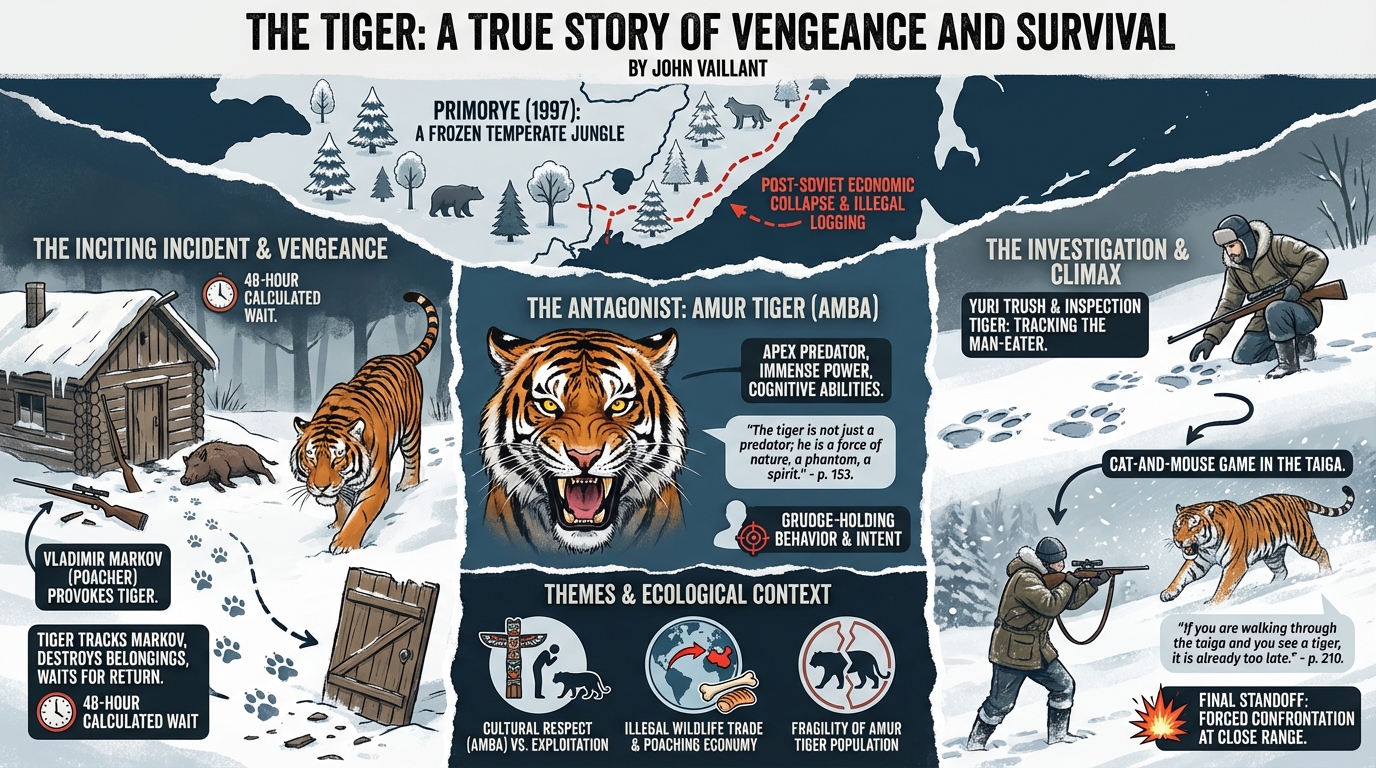
The narrative is set in December 1997 in Primorye, a remote region in the Russian Far East. This area is ecologically distinct, described as a “temperate jungle” where subarctic and subtropical ecosystems converge, allowing tigers, brown bears, and wolves to coexist with leopards and Asiatic black bears. Vaillant details the harsh socio-economic conditions following the collapse of the Soviet Union (Perestroika), which left rural communities without infrastructure or wages, driving many residents to illegal logging and poaching for survival.
The Inciting Incident
The central event is the death of Vladimir Markov, a poacher living in a remote cabin. Vaillant reconstructs the forensic evidence suggesting that Markov provoked an Amur tiger by shooting it and stealing its kill (a boar). The tiger did not attack immediately but engaged in calculated vengeance. It tracked Markov back to his cabin, destroyed his belongings—specifically targeting items with Markov’s scent—and waited by the door for his return, eventually killing and consuming him.
The Antagonist (The Amur Tiger)
The book provides an extensive biological and ethological profile of the Amur (Siberian) tiger. Unlike their Bengal counterparts, Amur tigers hunt in vast, snowy territories and possess immense physical power. Vaillant emphasizes the tiger’s cognitive abilities, memory, and capacity for grudge-holding.
“The tiger is not just a predator; he is a force of nature, a phantom, a spirit. He is the forest’s eyes and ears.” (p. 153)
The Investigation
The narrative follows Yuri Trush, a squad leader of “Inspection Tiger,” a specialized government unit tasked with investigating tiger attacks and preventing poaching. Trush serves as the primary lens through which the hunt is viewed. His journals and interviews provide the procedural backbone of the story as he tracks the animal through the deep snow of the taiga.
The Hunt and Survival
The book chronicles the cat-and-mouse game between Trush’s team and the tiger. The animal demonstrates strategic behavior, often flanking its pursuers and neutralizing their advantages. The narrative highlights the extreme danger of hunting an apex predator that is already hunting humans.
“If you are walking through the taiga and you see a tiger, it is already too late. He has been watching you for a long time.” (p. 210)
Cultural Relationship
Vaillant explores the indigenous Udege people’s spiritual connection to the tiger (often referred to as Amba), viewing it as a forest guardian that should not be disturbed. This creates a thematic contrast between the respectful coexistence of the indigenous population and the exploitative desperation of the post-Soviet settlers.
Ecological Commentary
The book serves as an examination of the illegal wildlife trade, specifically the demand for tiger parts in Traditional Chinese Medicine, which drives the poaching economy in Russia. It also addresses the fragility of the Amur tiger population, noting how individual losses can impact the genetic viability of the species.
The Climax
The standoff concludes when Trush is forced to confront the tiger at close range as it charges him. The detailed reconstruction of the shooting analyzes the split-second decisions made by the tracker and the biological resilience of the animal even after sustaining fatal wounds.
Anthropomorphism vs. Reality
Vaillant posits that while attributing human emotions to animals is scientifically controversial, the behavior of this specific tiger—waiting 48 hours for a specific target and systematically destroying that target’s possessions—strongly suggests a level of intent that mirrors human vengeance.
“There are no innocent bystanders in the forest.” (p. 112)
Further Reading
- Great Soul of Siberia: Passion, Obsession, and One Man’s Quest for the World’s Most Elusive Cat by Sooyong Park
- Man-Eaters of Kumaon by Jim Corbett
- Dersu Uzala by Vladimir Arsenyev
- Spell of the Tiger: The Man-Eaters of Sundarbans by Sy Montgomery
- Monster of God: The Man-Eating Predator in the Jungles of History and the Mind by David Quammen